
Tucked in the picturesque Bulgarian countryside, the medieval city of Veliko Târnovo is a major touristic hub. Perched over a rocky valley, above the deep-blue Yantra River, its terraced old town is almost too cute to handle. A joy to the eye, with fascinating architecture and a number of impressive historic landmarks, it’s simply timeless. So is the climbing next to it.
That’s right, Veliko Târnovo is also one of the top climbing destinations in Bulgaria. North of the city, the long stretch of limestone above the Yantra River is bound to make climbers turn their heads. That’s none other than Saint Trinity crag, one of Bulgaria’s oldest climbing areas.
Why go climbing in Veliko Târnovo?

Photo by Corina Dorina
I can think of a few good reasons…
One of them has to do with seasonality. The crags at Veliko Târnovo are at a relatively low elevation – about 200 meters. The climate is quite friendly and the routes get a lot of sun. Therefore, it’s possible to climb here in early spring and late autumn, sometimes on warmish winter days, too.
Then you have another very obvious reason – sport climbing routes for all levels. New lines continue to be bolted, and there’s potential for more.
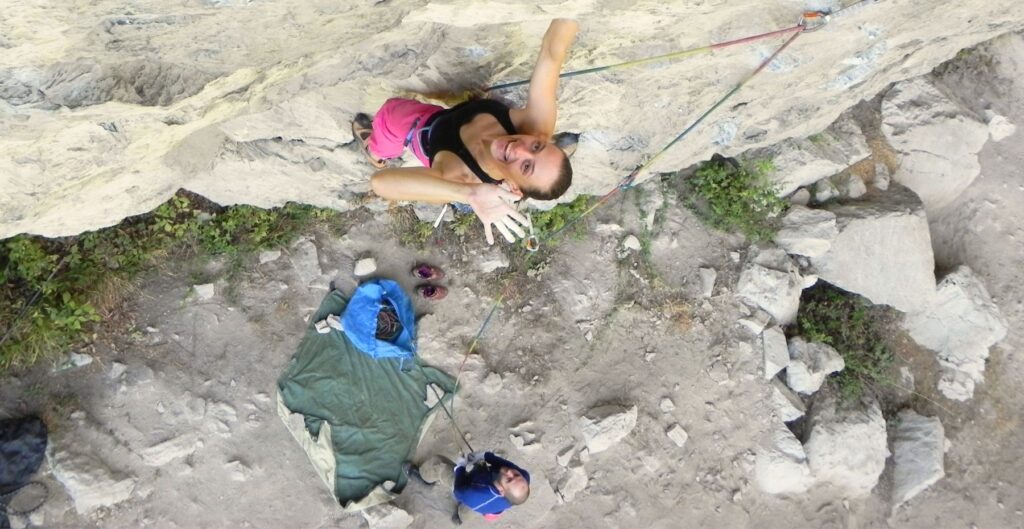
The main climbing crag in Veliko Târnovo is St. Trinity Rocks. Perched over the Yantra River Valley, just above the shrubbery, it offers picturesque views for both the climber and the belayer. That’s right, the base of the crag is a nice place to chill and even set up a hammock. Overall, the landscape is welcoming and it’s comfortable to belay on the mostly flat ground. Most of the sectors are child-friendly and you can even bring your non-climber friends and family.
Anything else? Oh yeah, south of the city you have Usteto Gorges, which have a bit to offer, too.
On top of all of these, climbing in Veliko Târnovo comes with the whole medieval city experience as a package deal. Go for a stroll on the winding cobbled streets, along the stacked houses of the picturesque Varosha Quarter (Old Town), visit Tsaravets Citadel, have a delicious Bulgarian meal, climb, and repeat.
Best time to climb in Veliko Târnovo

Photo by Corina Dorina
The best climbing seasons in Veliko Târnovo are spring and autumn. You’ll find the best conditions from March till May and again from September till November. Occasionally, it may be possible to climb here during winter months. On the other hand, summers can get really hot and it’s best to steer clear of climbing here during those months.
Climbing sectors in Veliko Târnovo

Photo by Corina Dorina
The largest climbing crag in Veliko Târnovo is St. Trinity Rocks (Sveta Troitsa), located to the north of the city. This is the visible long stretch of limestone, resembling a huge citadel wall, perched above the Yantra River. There are currently over 150 sport climbing routes at St. Trinity rocks, covering a variety of grades and ranging from 15 meters all the way to 80 meters long. Among these are some of Bulgaria’s oldest sport climbing routes, bolted way back in the 1980s (don’t worry, they’ve been rebolted since).
Then you have the climbing sectors of Usteto West and Usteto East (sometimes called “Ousteto”) to the south of the city. In total, they have close to 100 routes, from 10 meters to 40 meters long.
Unfortunately, at the time of writing, there’s no printed climbing guidebook for Veliko Târnovo. However, most climbers manage to get by with thecrag.com and local website climbingguide.bg.
Climbing at St. Trinity Rocks in Veliko Târnovo

North of Veliko Târnovo, St. Trinity crag gets its name from the Saint Trinity Monastery (to be more precise, this is convent). The climbing sectors are to the left of the monastery facing the crag.
St. Trinity Rocks offers something for every taste, with grades ranging from 5 all the way to 8b+ (some projects, too). The bulk of the routes are in the 5c to 7c+ range, which makes it an excellent playground for beginners and climbers looking to amp up their game.
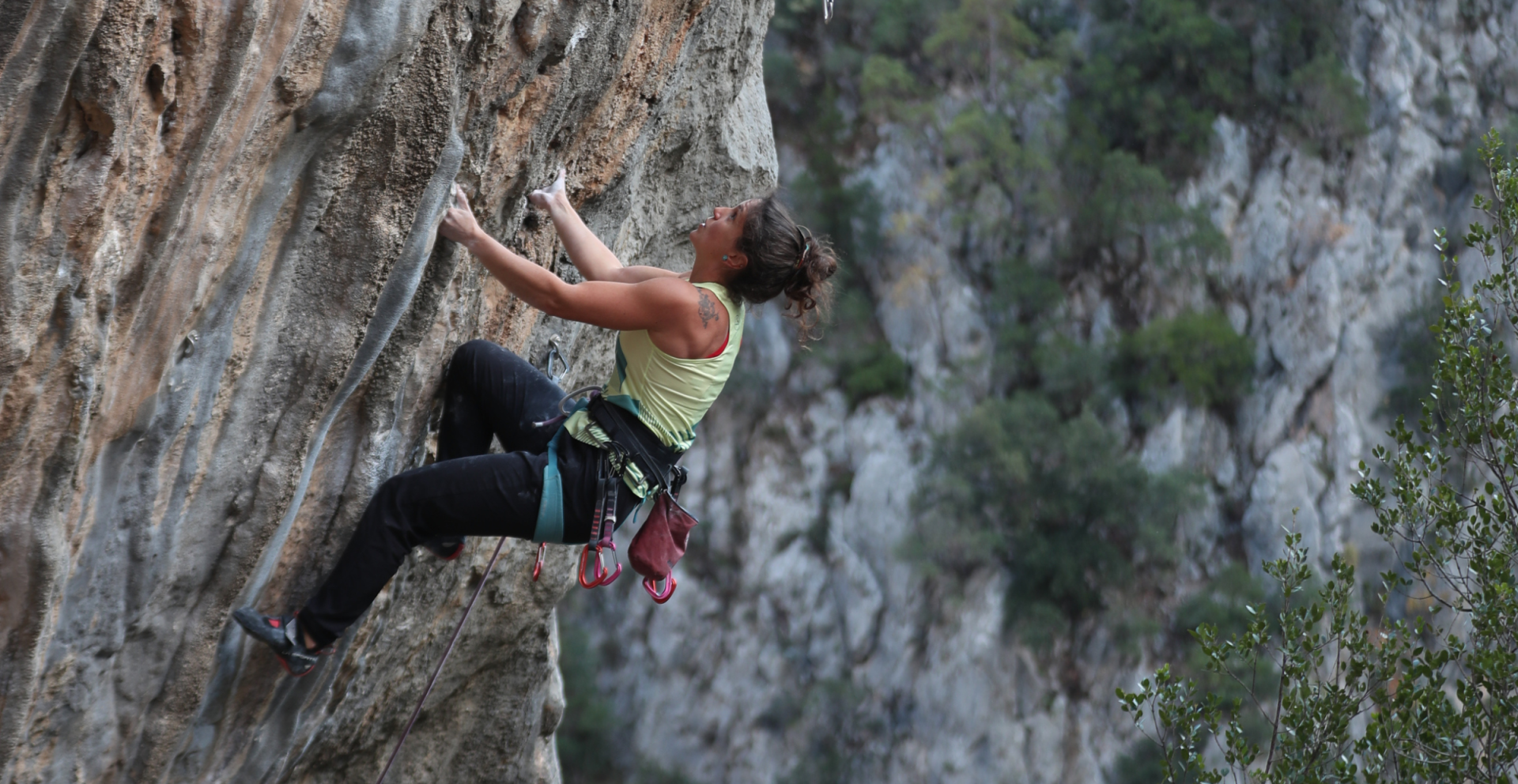
Most of the climbing is on vertical and steep limestone, with loads of crimps and pockets. There are some remarkable cracks, too, which are excellent for trad climbing. All in all, you’ll find short, bouldery routes as well as long, pumpy ones. Most of the lines are 20-25 meters long, with a few over 40 meters, some up to 80 meters long.
St. Trinity Rocks is divided into 7 sub-sectors spread over more than one kilometer. These are named from A to G, with sector A being the farthest to the left as you face the crag and sector G the closest to the monastery. Most of the sectors are flat and comfortable at the bottom, thus child-friendly.

Photo by Corina Dorina
Sector C is the most popular one, with some of the hardest routes in the whole area. This is the sector with the caves visible from the road down in the Yantra Valley. Most of the routes here are steep and overhanging, pumpy and physical, in the 7b+ to 8a+ range. There are a couple of warm-up routes, too, while the hardest lines here are around 8b and 8b+. The routes at this sector are rather short and bouldery, about 20 meters on average, with some shorter and longer ones here and there.
St. Trinity Rocks faces west and gets plenty of sun, making it a preferred climbing destination during colder months. The limestone is whitish, with stripes of orange-brown and dark gray here and there. Some of the older, more popular routes are a bit polished but, overall, the rock quality is pretty neat.
Getting to St. Trinity Rocks

Photo by Corina Dorina
From the northeastern part of Veliko Târnovo, take the road to Arbanasi and turn left after exiting the city. The narrow, winding road through the forest will take you to Sveta Troitsa – Saint Trinity Monastery. It’s about a 20-minute drive from downtown Veliko Târnovo to Saint Trinity Monastery (9-10 km). Park your car in the parking space just before the monastery. The convent is right beneath the limestone cliffs.
From the parking space, walk for 5-15 minutes to the climbing routes.
Depending on the sector you wish to reach, you can follow the dirt road and turn right after the convent, going uphill on a path towards the cliff. From there, you can walk to the left at the bottom of the sectors. Or you can follow the dirt road for a little longer and turn right on the paths through the bushes that lead to each sector.
Climbing at Usteto in Veliko Târnovo
South of Veliko Târnovo, Usteto Gorges (or Ousteto) are located just outside the city, about 5 km from the city center. Usteto East and Usteto West sit on opposite sides of the Yantra River, above road E85.
You’ll find lots of easy routes here, which makes these two crags great for beginners, even those who’ve never climbed before. But you’ll also find some challenging routes if that’s what you fancy.
Usteto East
Well…Usteto East actually faces west.
There are about 25 sport climbing routes here, mostly in the 5a to 6a+ range, with a couple of harder lines, too. The routes vary in length, from short 10-meter ones to 40-meter ones.
Getting to Usteto East
Usteto East is within walking distance from Veliko Târnovo. Follow road E85 toward the southern exit (the industrial zone). From there, you need to get to the railway lines and walk along them for approximately 15 minutes. Although trains are not that frequent, you should be careful.
Usteto West
Aaaand…Usteto West faces east.
Opposite of Usteto East, above the road, this crag has 50+ bolted routes. The majority are short, but there are a few that are 35-40 meters long. Most of the routes are in the 5b to 6a+ range, predominantly vertical and crimpy. There are a couple of 7c’s and a 7c+, too.
Getting to Usteto West
There is a road leading to a meadow right above the crag. It takes about 10 minutes by car to get to it from Veliko Târnovo.
While we’re here, I should also mention the world-class climbing area at Dryanovo Monastery, only 30 km or so from Veliko Târnovo, home to some of Bulgaria’s best sport climbing routes.
Where to stay in Veliko Târnovo
Accommodation

Veliko Târnovo is a touristic city, so there’s no shortage of accommodation options. There are hotels and guesthouses to suit every fancy and budget.
You can’t go wrong with a room in the Old Town, where you’ll be close to the restaurants, bars, and cafes, as well as many other tourist attractions. If you can find one overlooking Tsarevets, Veliko Târnovo’s emblematic fortress, that’s even better.
Alternatively, you can opt for an accommodation in Arbanasi and nearby Samovodene, too.
Camping
Currently, there’s only one campsite in the area. Camping Veliko Târnovo is a camping and glamping site about 20 minutes from Veliko Târnovo by car, in the village of Dragizhevo. Unfortunately, this campsite is only open during the warm season, from April till the end of September.
Getting there

If you travel by car, it’s easy peasy. If you don’t, then you should know that the “nearest” airports aren’t that “near”. So, renting a car might be the best option.
Plovdiv Airport (PDV) is 220 km from Veliko Târnovo, Bucharest International Airport (OTP), in Romania, is 200 km away, while Sofia International Airport (SOF) is about 240 km from Veliko Târnovo. Luckily, there are regular buses and trains between Sofia and Veliko Târnovo.
Read more >> Climbing in Romania: All You Need to Know
Getting around

It’s easy to get around the city on foot, bike, or by public transport. But, if you plan to go climbing in Veliko Târnovo, it’s best to have a car. Even more so if you want to climb at St. Trinity Rocks, because there’s no public transport there.
Veliko Târnovo is not a large city, but it does have pretty much anything you might need. There is a Decathlon store and an outdoor shop where you can find camping and climbing gear. For provisions, there are several supermarkets, even a mall.
Rest days
There sure is plenty to do in and around Veliko Târnovo when you’re not climbing. There’s Veliko Târnovo’s Old Town, with its fascinating, well-preserved architecture, Tsaravets Citadel, the neighboring quaint villages, the likes of Arbanasi, and the superb national parks in the region.
Explore Veliko Târnovo’s Old Town

Stroll down the winding narrow streets of Veliko Târnovo’s Old Town, with their distinctive medieval flair. See, taste, smell, and feel the Bulgarian, Macedonian, Greek, and Albanian influences at every step.
In the heart of the Old Town, Varosha Quarter, with its enchanting cobbled streets, is the perfect place for an afternoon stroll. Its unique architecture, with labyrinthine alleys and ebony and ivory houses perched above the valley, stacked in perfect order, is simply picture-perfect.
Make sure you go down Gurko Street, the most famous street in the city. And visit Samovodska Charshia, the old market street, lined with all sorts of craft and antique shops; a great place to stock up on souvenirs.
Sure, it may take less than two hours to cover the Old Town, but you certainly cannot get bored here. Veliko Târnovo is Bulgaria’s second most prestigious university center. So, the city is very much alive any time of year.
Visit Tsaravets Citadel

The symbol of Veliko Târnovo, perched above the winding valley and over the old terracotta-tiled roofs, Tsarevets is a natural fortress surrounded by the Yantra River on three sides.
You could spend a whole day exploring Tsarevets, the Palace of the Tsars. After passing through the three (yes, three!) entrance gates, you can stroll down the winding paths along the main attractions in complete freedom. There are no guides, no restrictions, and no limit to how much time you spend here.
Watch Veliko Târnovo’s Sound and Light Show
The Sound and Light Show uses lights, medieval music, and church bells to put on a dramatic show that brings to life the city’s key historical events. Lasers and multicolored lights envelop the Tsaravets Citadel after dark, taking viewers far back in time to the Thracians and Slavs, the Roman and Byzantine invasions, the rise and fall of the Second Bulgarian Empire, all the way to the Russo-Turkish War and the country’s rise to independence.
On bank holidays, the show is free to watch. On other occasions, viewers need to buy tickets and watch the show from special viewing decks. Regardless, if the show is on, you can always savor it from a distance.
Visit Arbanasi
It would certainly be worthwhile taking a day or afternoon to visit the neighboring village of Arbanasi, some 10 km from Veliko Târnovo. Located on a rocky plateau, this small, quaint village with a medieval flair is on the UNESCO World Heritage List and is famous for its charming architecture and old churches.
* This article contains affiliate links, which means I may get a commission to fund my travels if you decide to make a purchase through my links. This, of course, comes at no additional cost to you.